Business continuity is not a document stored for emergencies. It is the organization’s ability to keep critical services operating, make decisions under pressure and recover deliberately when normal conditions fail.
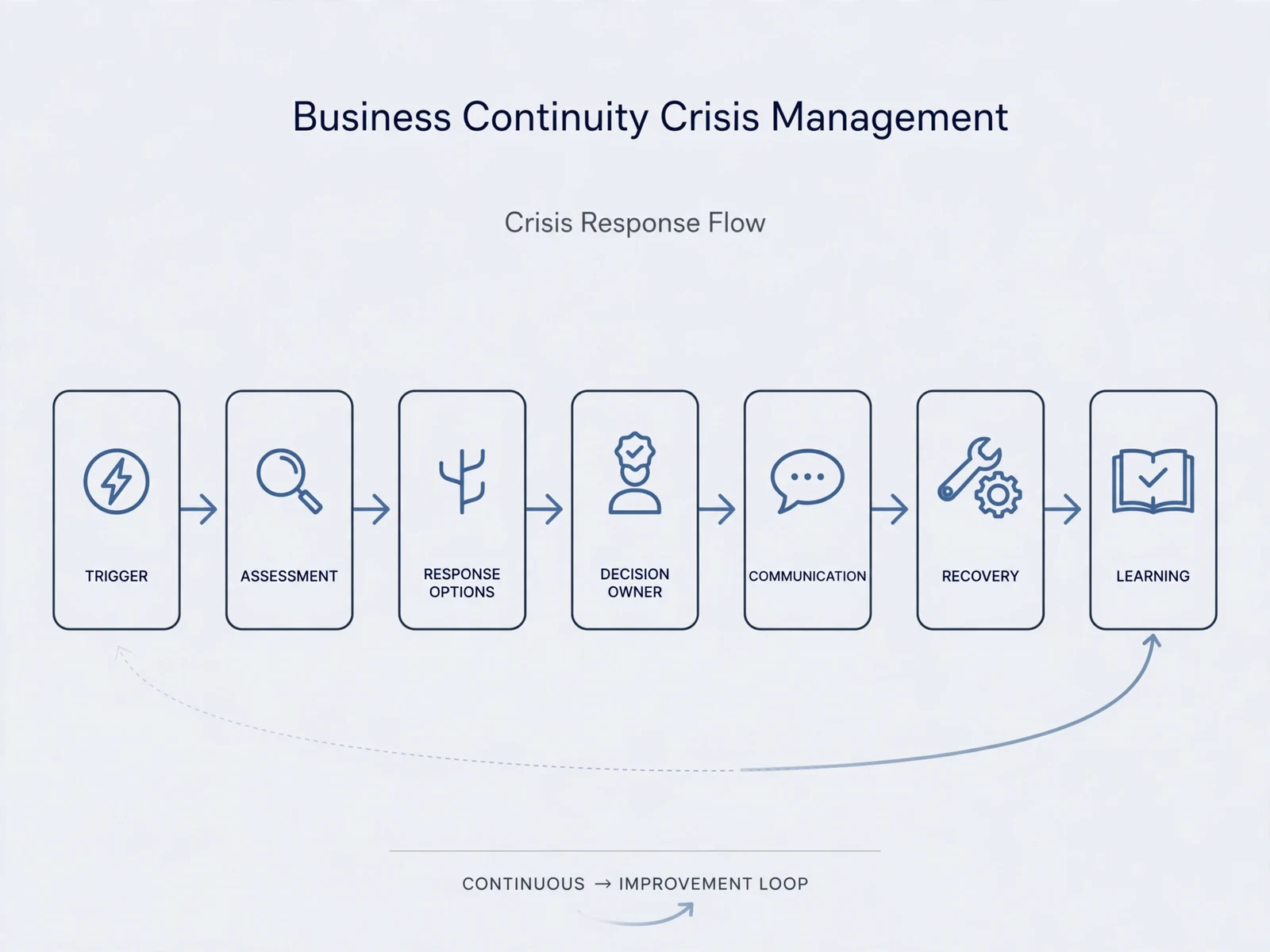
Course Overview
This program is for managers, risk professionals, operations leaders and continuity coordinators responsible for resilience, crisis response or critical services. It connects business continuity planning with practical crisis leadership.
Participants identify critical activities, assess disruption impact, examine dependencies, design continuity strategies and practise crisis decisions and communication. The emphasis is on usable arrangements rather than paperwork.
For organizations, the course can support resilience programs, continuity teams, operational risk initiatives and leaders who may serve on crisis-management teams.
Where this program fits
Business continuity, risk, operations, facilities, technology and functional leaders with resilience responsibilities
Live classroom, live online or private in-house. Depth and schedule are tailored to the cohort.
Critical services, business impact, dependencies, continuity strategies, crisis roles, communication, exercises and recovery
A continuity and crisis-readiness plan for a critical business area
Built for Corporate Cohorts
Private delivery can be aligned to participant roles, business priorities, internal terminology and real workplace scenarios. HR, L&D and functional sponsors can use the course alone or inside a broader academy.
What Participants Will Learn
Distinguish activities the organization must protect from those that can wait.
Understand time, customer, financial, regulatory and operational consequences.
Identify people, technology, suppliers, locations and information required for continuity.
Choose realistic workarounds, alternate capacity and recovery priorities.
Clarify decision roles, escalation and communication under pressure.
Use scenarios and lessons learned to strengthen readiness.
Business Problems This Program Is Designed to Address
Course Outline
Applied Practice and Scenario Work
Participants use realistic situations to practise analysis, decisions, stakeholder communication and application. Private cohorts can adapt scenarios to the organization’s context while protecting confidential information.
Participants prioritize services, workarounds, escalation and stakeholder communication.
Participants coordinate continuity actions across procurement, operations and customer teams.
Participants establish situation reporting and decision authority.
Participants plan recovery sequencing rather than assuming normal service returns immediately.
Practical Tools and Work Products
What Strong Practice Looks Like
Strong continuity planning begins with what the organization must continue to deliver, not with a template. Managers need to know which products, services, processes and obligations are time-critical and how quickly disruption becomes unacceptable.
Dependencies make continuity complex. A process can appear robust until a single system, supplier, specialist, building or data source becomes unavailable. Participants learn to make those dependencies visible and assess whether alternatives are genuinely viable.
Crisis management requires a different operating rhythm from normal management. Information is incomplete, time pressure is higher and routine approval structures may be too slow. Leaders need pre-defined authority, escalation principles and a reliable method for building shared situational awareness.
Recovery is also a management phase. Restoring a system does not automatically clear backlog, customer impact or operational risk. Plans should explain how the organization moves from emergency arrangements back toward stable operations.
Questions Participants Learn to Ask
Which activity becomes unacceptable to lose first?
Which dependency has no realistic alternative?
Who has authority to make time-critical decisions during disruption?
What must be prioritized during recovery rather than simply restarted?
Implementation Pitfalls and Cross-Functional Interfaces
Capability in this topic depends on how decisions move across the organization. Private cohorts can map where ownership, information or incentives currently break down and use those interfaces as part of the learning design.
- Technology and cybersecurity for system recovery
- Procurement for critical suppliers and alternate sourcing
- Communications and HR for employee and stakeholder messaging
- Executive leadership for crisis authority and strategic trade-offs
A common implementation mistake is to add a framework without changing the management routine around it. Participants therefore identify where the tool will be used, who needs to be involved, what evidence is required and what decision or behavior should become different after application.
Advanced Application Considerations
Continuity plans can become over-engineered when every possible event is documented separately. A more resilient approach often focuses on loss of capability, such as loss of site, technology, supplier, people or data, because many different events can create the same operational problem.
Another challenge is unrealistic recovery assumptions. A plan may name an alternate supplier, remote-work option or backup system without confirming capacity, access, contractual rights or testing. Participants learn to distinguish a stated fallback from a validated continuity strategy.
Exercises should also test leadership judgement, not only procedure. Useful scenarios introduce uncertainty, changing information and competing priorities so leaders practise escalation, trade-offs and communication rather than simply following a checklist.
Before the Program Begins
For a private cohort, participants can identify one current case, decision or recurring problem related to the topic. Anonymized patterns can be used to weight practice without turning the program into a review of confidential internal matters.
After the Program
Participants can use one work product in the next relevant work cycle and discuss the result with a manager or peer. The goal is to reinforce application while the participant has a live opportunity to use the capability.
How Participants Work During the Program
The learning design moves through diagnosis, practice, challenge and application. Participants begin with a real problem or decision, test a framework, receive challenge, build a practical work product and identify the first workplace action after the course.
For employer-sponsored cohorts, managers can agree one current situation before delivery and review the participant’s application afterward. This creates a direct connection between learning and work without turning development into a heavy assessment exercise.
Manager Reinforcement and Evidence of Application
Sponsors can look for observable changes such as clearer decisions, stronger preparation, better use of a work product, improved ownership or better escalation. These are indicators that the capability is being applied, not automatic claims that attendance caused a business result.
Participants should select one or two applications first rather than trying to use every concept at once. Managers can ask what was tried, what response followed and what should be adjusted next time.
Designing a Private Cohort Around Real Work
Before private delivery, the sponsor can define participant roles, experience level, common workplace situations, internal terminology and one or two practical outputs that would be useful after the program.
- Participant roles and experience.
- Recurring decisions or problems the cohort needs to handle better.
- Relevant internal frameworks or governance.
- Practical work products participants can use afterward.
- How managers will reinforce application.
Capability Maturity and Leadership Decisions
Continuity maturity also depends on ownership outside the resilience function. Business leaders need to understand their critical activities, recovery priorities and dependencies rather than assuming the continuity team will solve disruption for them. Participants examine how responsibility is distributed before, during and after an incident.
Crisis communication requires disciplined uncertainty. Leaders may need to communicate before every fact is known. The program develops a practical standard: state what is confirmed, what is still being investigated, what action people should take now and when the next update will be provided.
For corporate cohorts, participants can compare current practice with a more mature operating model and identify the smallest change that would materially improve decision quality. That keeps the action plan practical while still showing what stronger capability looks like over time.
Who Should Attend
- Business continuity and resilience professionals
- Risk and operations managers
- Crisis-management team members
- Functional leaders responsible for critical services
Organizational Benefits
- Improve continuity readiness
- Strengthen crisis decision-making
- Expose critical dependencies before disruption
- Create more practical recovery strategies
- Build shared resilience capability across functions
Delivery and Pricing
The program is live and instructor-led. It can be delivered in the classroom, live online or in-house. Duration is flexible and should reflect participant level, selected depth, organizational objectives and the amount of applied practice required.
Public and private pricing: current public fees are confirmed with scheduled cohorts. Private and customized programs are quoted according to cohort size, location, scope and customization. Request a proposal.
Frequently Asked Questions
Can this be delivered privately for one organization?
Yes. Private cohorts can be calibrated to participant roles, business context and priority scenarios.
Is the duration fixed?
No. Delivery depth and schedule are adapted to the cohort and learning objective.
Can we use our own scenarios?
Yes. Organization-relevant situations can be used while protecting confidential information.
How should managers reinforce the learning?
Agree one or two work applications, then review what the participant tried, what happened and what should change next.
Can this sit inside a broader academy?
Yes. It can be combined with related programs into a role, function or leadership pathway.
Is this self-paced?
No. TheSkillGrid programs are live and instructor-led.
Related Programs
- Risk Management in Projects
- Corporate Governance Essentials
- Change Management and Organizational Transformation
- Strategic Planning and Execution
Build a Cohort Around the Capability Need
TheSkillGrid can combine this course with adjacent programs into a coherent corporate pathway.
Upcoming Dates & Venues
Request course availability with your preferred date, location and group size. We will confirm available public-session and private-team options before any booking or payment.
Ready to Take the Next Step?
Register your interest for a public session or request private in-house delivery for your team.