Strategic thinking is the discipline of seeing beyond the immediate problem, understanding the system around a decision and making trade-offs before resources are committed.
Course Overview
This program develops strategic judgement for managers and leaders whose roles are expanding beyond day-to-day execution. It focuses on issue framing, systems thinking, scenarios, priorities, assumptions and decision communication.
Participants work with ambiguous business questions where evidence is incomplete and multiple options may be defensible. The emphasis is on making decision logic visible.
Organizations can use the course in high-potential programs, leadership academies and succession development.
Where this program fits
Managers, senior specialists, high-potentials and leaders preparing for broader responsibility
Live classroom, live online, or private in-house delivery. Depth and schedule are tailored to the cohort.
Strategic framing, systems thinking, scenarios, assumptions, trade-offs and recommendations
A strategic decision brief for a live business priority
Built for Corporate Cohorts
Private delivery can be calibrated to participant roles, internal frameworks, business priorities and real workplace scenarios. HR, L&D and functional sponsors can use the program as a standalone intervention or inside a broader academy, leadership pathway or capability initiative.
What Participants Will Learn
Separate the decision from symptoms and noise.
Identify dependencies, incentives and second-order effects.
Explore plausible futures without false certainty.
Compare options against strategic criteria.
Test what must be true for an option to work.
Present choices, consequences and a clear decision ask.
Business Problems This Program Is Designed to Address
The course is organized around workplace problems that managers and organizations can observe, not around theory alone.
Course Outline
Applied Practice and Scenario Work
Participants use realistic situations to practise analysis, decisions, stakeholder communication and application. Private cohorts can adapt the scenarios to the organization’s environment while keeping sensitive information protected.
Practical Tools and Work Products
How Participants Work During the Program
The learning design moves through diagnosis, practice, challenge and application. Participants define a real problem, test a framework or conversation, build a work product, receive challenge and identify where the learning will be used after the course. This keeps the program anchored in actual work rather than passive attendance.
Define the real problem or decision.
Test tools, language and decisions.
Create a work product for the role.
Set the first workplace action and evidence.
Who Should Attend
- Managers moving into broader leadership roles
- Senior specialists
- High-potential employees
- Organizations developing strategic judgement
Organizational Benefits
- Strengthen strategic thinking below executive level
- Improve cross-functional decisions
- Prepare managers for broader responsibility
- Create a common language for trade-offs
- Connect development to live business priorities
For HR, L&D and Program Sponsors
Before private delivery, sponsors can define the target population, current responsibilities, capability gaps, organizational terminology and priority scenarios. Participants can then be asked to apply one or two tools to live work and review what happened with their manager after the program. This creates observable application without making unsupported claims that attendance alone caused a business result.
What Strong Strategic Thinking Looks Like in Practice
Strategic thinking changes the level at which a manager examines a problem. Instead of asking only how to execute the current plan, the leader asks whether the problem is framed correctly, which external or internal forces matter and what consequences today’s choice may create elsewhere in the organization.
Systems thinking helps because important decisions rarely sit inside one department. Pricing affects demand, operations and margin. A technology choice affects process, skill and risk. A restructuring affects accountability and customer experience. Mapping those relationships allows leaders to see second-order effects before they become surprises.
Scenarios are useful when uncertainty is material. They do not predict the future. They help leaders identify which assumptions matter most, how different conditions would affect the choice and which signals should be monitored. That makes strategy more adaptable without turning it into constant reaction.
Finally, strategic thinking requires the ability to choose. A list of priorities is not a strategy if everything remains important. Leaders need explicit criteria, opportunity-cost thinking and a recommendation that explains what the organization should do, what it should not do and why.
Questions Participants Learn to Ask
What decision are we actually making?
Which dependencies or second-order effects could change the outcome?
Which assumption matters most to the recommendation?
What are we choosing not to do if we pursue this option?
Manager Reinforcement and Evidence of Application
For employer-sponsored participants, the program can be connected to a live work priority before delivery begins. The participant and manager can agree where the learning is most likely to be useful, what decision or conversation is approaching, and which course tool should be tested first.
Immediately after the course, participants should select a small number of applications rather than trying to use everything at once. The manager can review what was tried, what evidence was used, what response followed and what should be adjusted next time.
At cohort level, HR, L&D or the functional sponsor can look for patterns such as clearer decision briefs, stronger preparation, better use of a work product, more explicit trade-offs or improved ownership. These are observable signs of application, not automatic claims that the course caused a business result.
Implementation Pitfalls and Cross-Functional Interfaces
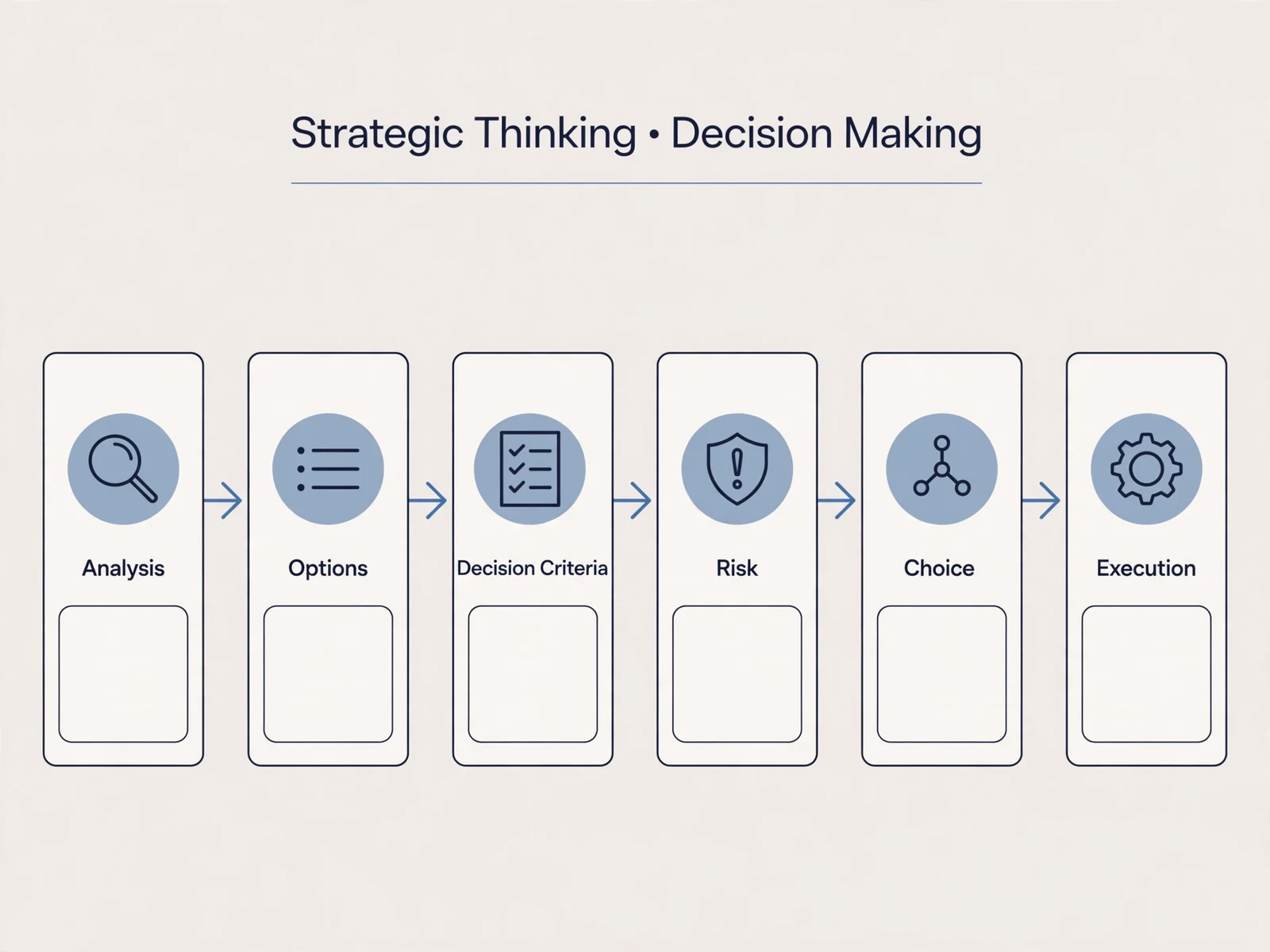
Strategic discussions often become too broad because leaders mix diagnosis, option generation and decision at the same time. Participants learn to separate those stages so the group is clear about what question is being answered and which criteria will be used.
A second pitfall is allowing current organizational boundaries to define the problem. Strategic issues often cut across customers, capabilities, finance, technology and people. The course encourages leaders to frame the system before assigning ownership.
Execution risk also needs to be part of the strategic choice. An option may be attractive in principle but depend on capabilities, timing or stakeholder support the organization does not currently have. Participants learn to incorporate feasibility without reducing strategy to what is easiest today.
Important Cross-Functional Interfaces
- Finance for investment and resource trade-offs
- Operations for feasibility and capacity
- HR for capability and organizational implications
- Technology, risk or commercial leaders depending on the strategic question
For a private cohort, these interfaces can be used to make the learning more realistic. Participants can map where decisions move between functions, where information is lost and where clearer ownership or escalation is required. When the program sits inside a wider academy, the same issues can be revisited in later modules so capability development is connected across subjects.
Designing a Private Cohort Around Real Work
When Strategic Thinking and Decision Making is delivered for one organization, the strongest starting point is not a generic request to cover the topic in more detail. The sponsor should identify the participant population, the situations those participants are expected to handle, the decisions that currently create difficulty and any internal frameworks or terminology the facilitator should understand before delivery.
The course can then be calibrated without becoming a narrow internal-process briefing. The core professional principles remain intact, while examples, scenario emphasis and work products reflect the responsibilities of the cohort. This is particularly useful when participants come from several functions and need a shared language without pretending their roles are identical.
- Participant roles and experience level.
- Two or three recurring workplace situations where stronger capability is needed.
- Relevant internal language, governance or decision frameworks.
- One practical output participants could use after the program.
- How managers will support application once participants return to work.
Delivery and Pricing
The program is live and instructor-led. It can be delivered in a classroom, live online, or in-house. Duration is flexible and should reflect participant level, selected depth, organizational objectives and the amount of applied practice required.
Public and private pricing: current public fees are confirmed with scheduled cohorts. Private and customized programs are quoted according to cohort size, location, scope and customization. Request a proposal.
Frequently Asked Questions
Can this be delivered privately for one organization?
Yes. The course can be delivered as a dedicated cohort and calibrated to the participant population and operating context.
Is the duration fixed?
No. Delivery depth and schedule are adapted to the cohort and learning objective.
Can we use our own scenarios?
Yes. Private cohorts can use role-relevant situations and internal terminology while protecting confidential material.
How should managers reinforce the learning?
Agree one or two work applications and review what the participant tried, what changed and what further support is needed.
Can this sit inside a larger academy?
Yes. The course can be combined with related programs into a function-specific or leadership pathway.
Is this a self-paced course?
No. TheSkillGrid programs are live and instructor-led.
Related Programs
- Strategic Planning and Execution
- Finance for Senior Executives
- Advanced Leadership and Executive Presence
- Change Management and Organizational Transformation
Build a Cohort Around Your Capability Priorities
TheSkillGrid can combine this program with adjacent courses into a structured corporate academy or pathway.
Upcoming Dates & Venues
Request course availability with your preferred date, location and group size. We will confirm available public-session and private-team options before any booking or payment.
Ready to Take the Next Step?
Register your interest for a public session or request private in-house delivery for your team.