Enterprise Risk Management for Managers and Leaders
View Dates & OptionsRisk management becomes useful when it changes a decision. A register alone does not protect an organization unless leaders understand exposure, ownership, controls and when a different choice is required.
Course Overview
This program develops enterprise-risk capability for managers and leaders who own business outcomes, not only for specialist risk teams. It connects risk to objectives, decisions and operating responsibility.
Participants work with strategic, operational, supplier, project, people, data and reputational risk scenarios. The emphasis is on clear articulation of exposure, proportionate assessment, risk appetite, control design and escalation.
Organizations can use the program in manager academies, governance pathways or risk-culture initiatives.
Where this program fits
Managers, business leaders, operational leaders and risk owners
Live classroom, live online, or private in-house delivery. Depth and schedule are tailored to the cohort.
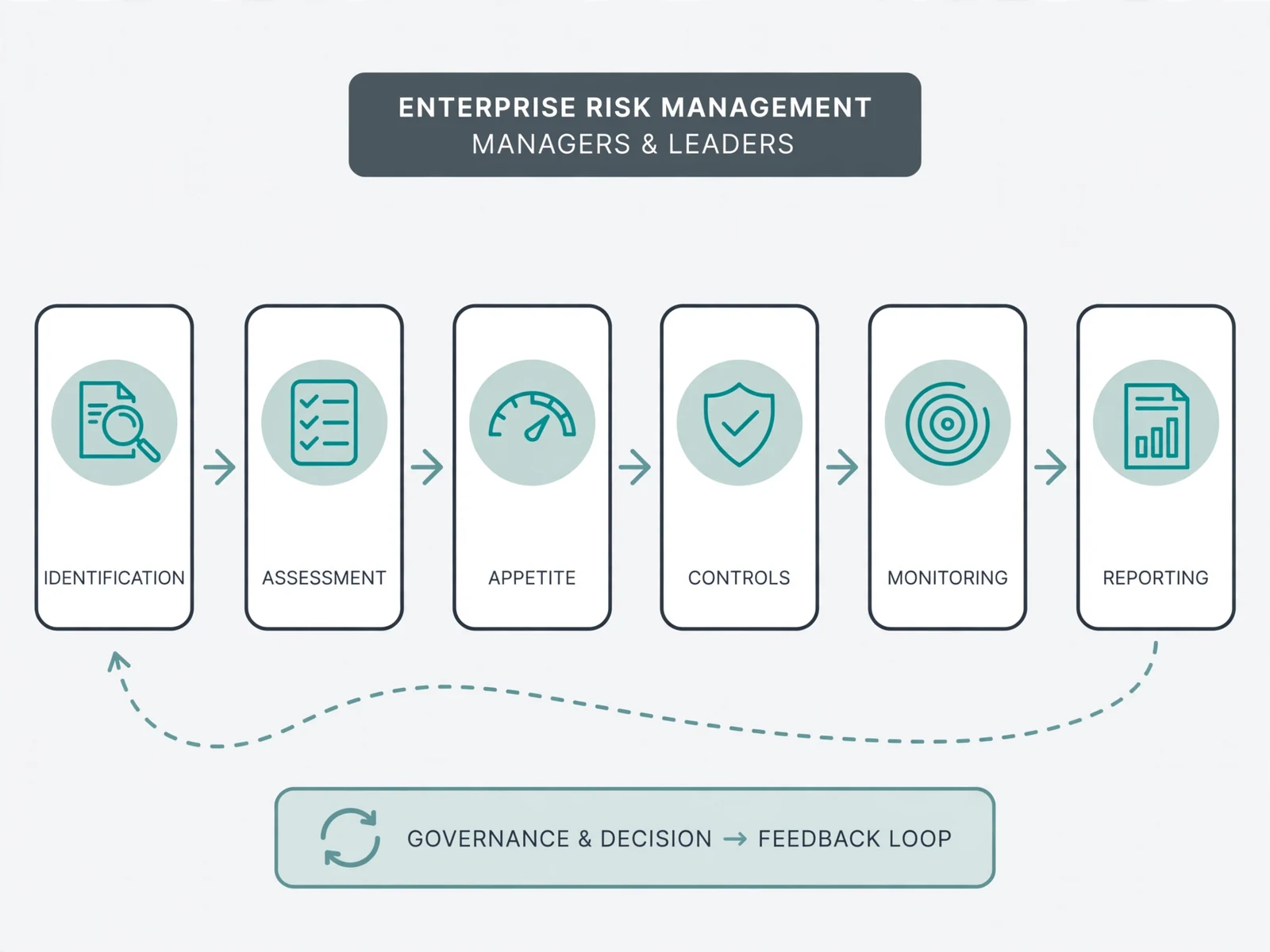
Risk identification, appetite, assessment, controls, ownership, escalation and communication
A risk map and response plan for a live area of responsibility
Built for Corporate Cohorts
Private delivery can be calibrated to participant roles, internal frameworks, business priorities and real workplace scenarios. HR, L&D and functional sponsors can use the program as a standalone intervention or inside a broader academy, leadership pathway or capability initiative.
What Participants Will Learn
Connect uncertainty to objectives and business consequences.
Use likelihood, impact and vulnerability without false precision.
Translate organizational appetite into practical decisions.
Match controls to the cause and consequence being managed.
Separate risk ownership, control ownership and assurance.
Communicate risk, options and decisions at the right level.
Business Problems This Program Is Designed to Address
The course is organized around workplace problems that managers and organizations can observe, not around theory alone.
Course Outline
Applied Practice and Scenario Work
Participants use realistic situations to practise analysis, decisions, stakeholder communication and application. Private cohorts can adapt the scenarios to the organization’s environment while keeping sensitive information protected.
Practical Tools and Work Products
How Participants Work During the Program
The learning design moves through diagnosis, practice, challenge and application. Participants define a real problem, test a framework or conversation, build a work product, receive challenge and identify where the learning will be used after the course. This keeps the program anchored in actual work rather than passive attendance.
Define the real problem or decision.
Test tools, language and decisions.
Create a work product for the role.
Set the first workplace action and evidence.
Who Should Attend
- Business managers
- Operational leaders
- Project and program leaders
- Managers responsible for governance or control
Organizational Benefits
- Embed risk thinking in normal management decisions
- Improve risk ownership and escalation
- Strengthen governance outside specialist teams
- Reduce weak control design
- Build a common risk language across functions
For HR, L&D and Program Sponsors
Before private delivery, sponsors can define the target population, current responsibilities, capability gaps, organizational terminology and priority scenarios. Participants can then be asked to apply one or two tools to live work and review what happened with their manager after the program. This creates observable application without making unsupported claims that attendance alone caused a business result.
What Strong Risk Leadership Looks Like in Practice
Risk leadership starts with the objective that could be affected. Without that connection, risk discussions can become lists of bad things that might happen. Managers need to describe the cause, uncertain event and consequence clearly enough that another leader can understand why the exposure matters and what decision is required.
Assessment should be proportionate rather than falsely precise. A simple likelihood-impact view may be sufficient for many operational risks, while major strategic or financial exposures may need scenarios, sensitivity analysis or deeper specialist input. The important point is that the assessment improves a decision rather than creating an illusion of mathematical certainty.
Risk appetite becomes useful when it changes behavior. Leaders need practical thresholds for what can be accepted locally, what requires additional control and what must be escalated. This is especially important when the organization is deliberately taking risk to pursue growth, innovation or transformation.
Control design also benefits from clearer logic. Managers should know which risk a control addresses, whether it is intended to prevent, detect or correct a failure, who operates it and what evidence shows that it is working. Adding more controls is not automatically safer if responsibility becomes unclear or controls do not address the real cause.
Questions Participants Learn to Ask
Which objective is exposed and how?
What residual risk remains after current controls?
Is the exposure inside the organization’s practical appetite?
What decision or escalation is required now?
Manager Reinforcement and Evidence of Application
For employer-sponsored participants, the program can be connected to a live work priority before delivery begins. The participant and manager can agree where the learning is most likely to be useful, what decision or conversation is approaching, and which course tool should be tested first. This prevents the program from becoming separate from the participant’s real responsibilities.
Immediately after the course, participants should select a small number of applications rather than trying to use everything at once. The manager’s role is not to test whether the participant remembers course terminology. It is to ask what they tried, what evidence they used, what response they received, and what they would adjust the next time a similar situation occurs.
At cohort level, HR, L&D or the functional sponsor can look for patterns in application. Useful evidence may include clearer decision briefs, stronger meeting preparation, better use of a work product, more explicit trade-offs, improved escalation, clearer ownership, or a more consistent management routine. These are observable signs of application, not automatic claims that the course alone caused a business result.
Implementation Pitfalls and Cross-Functional Interfaces
Risk management loses credibility when it becomes separate from planning and performance. Managers may complete a register because governance requires it, then make operational decisions without referring to the exposure. The program integrates risk questions into normal choices about projects, suppliers, people, investments and priorities.
A second pitfall is excessive scoring. More detailed matrices do not necessarily create better judgement. Participants focus on what evidence changes the assessment, what uncertainty remains and which decision is required at the current level.
Risk escalation can also fail in two directions. Some managers escalate every uncertainty and overwhelm senior forums, while others retain material exposure too long. Participants define practical triggers based on impact, appetite, control weakness and decision authority.
Important Cross-Functional Interfaces
- Finance when financial exposure or capital decisions are involved
- Legal and compliance for regulatory or contractual risk
- Operations and project teams for control ownership
- Executive or board governance when exposure exceeds local authority
For a private cohort, the facilitator can use these interfaces to make the learning more realistic. Participants can map where decisions currently move between functions, where information is lost, and where the organization needs clearer ownership or escalation. This is particularly useful when the course is part of a broader academy because later programs can build on the same cross-functional issues.
Designing a Private Cohort Around Real Work
When Enterprise Risk Management for Managers and Leaders is delivered for one organization, the strongest starting point is not a generic request to cover the topic in more detail. The sponsor should identify the participant population, the situations those participants are expected to handle, the decisions that currently create difficulty and any internal frameworks or terminology the facilitator should understand before delivery.
The course can then be calibrated without becoming a narrow internal-process briefing. The core professional principles remain intact, while examples, scenario emphasis and work products reflect the responsibilities of the cohort. This is particularly useful when participants come from several functions and need a shared language without pretending their roles are identical.
- Participant roles and experience level.
- Two or three recurring workplace situations where stronger capability is needed.
- Relevant internal language, governance or decision frameworks.
- One practical output participants could use after the program.
- How managers will support application once participants return to work.
Delivery and Pricing
The program is live and instructor-led. It can be delivered in a classroom, live online, or in-house. Duration is flexible and should reflect participant level, selected depth, organizational objectives and the amount of applied practice required.
Public and private pricing: current public fees are confirmed with scheduled cohorts. Private and customized programs are quoted according to cohort size, location, scope and customization. Request a proposal.
Frequently Asked Questions
Can this be delivered privately for one organization?
Yes. The course can be delivered as a dedicated cohort and calibrated to the participant population and operating context.
Is the duration fixed?
No. Delivery depth and schedule are adapted to the cohort and learning objective.
Can we use our own scenarios?
Yes. Private cohorts can use role-relevant situations and internal terminology while protecting confidential material.
How should managers reinforce the learning?
Agree one or two work applications and review what the participant tried, what changed and what further support is needed.
Can this sit inside a larger academy?
Yes. The course can be combined with related programs into a function-specific or leadership pathway.
Is this a self-paced course?
No. TheSkillGrid programs are live and instructor-led.
Related Programs
- Corporate Governance Essentials
- Risk Management in Projects
- Vendor Management and Negotiation
- Strategic Planning and Execution
Build a Cohort Around Your Capability Priorities
TheSkillGrid can combine this program with adjacent courses into a structured corporate academy or pathway.
Upcoming Dates & Venues
Request course availability with your preferred date, location and group size. We will confirm available public-session and private-team options before any booking or payment.
Ready to Take the Next Step?
Register your interest for a public session or request private in-house delivery for your team.