Managers often ask what they should delegate when the better question is what work should still belong to the manager at all.
A delegation matrix helps separate four categories: keep, delegate, develop, and stop.
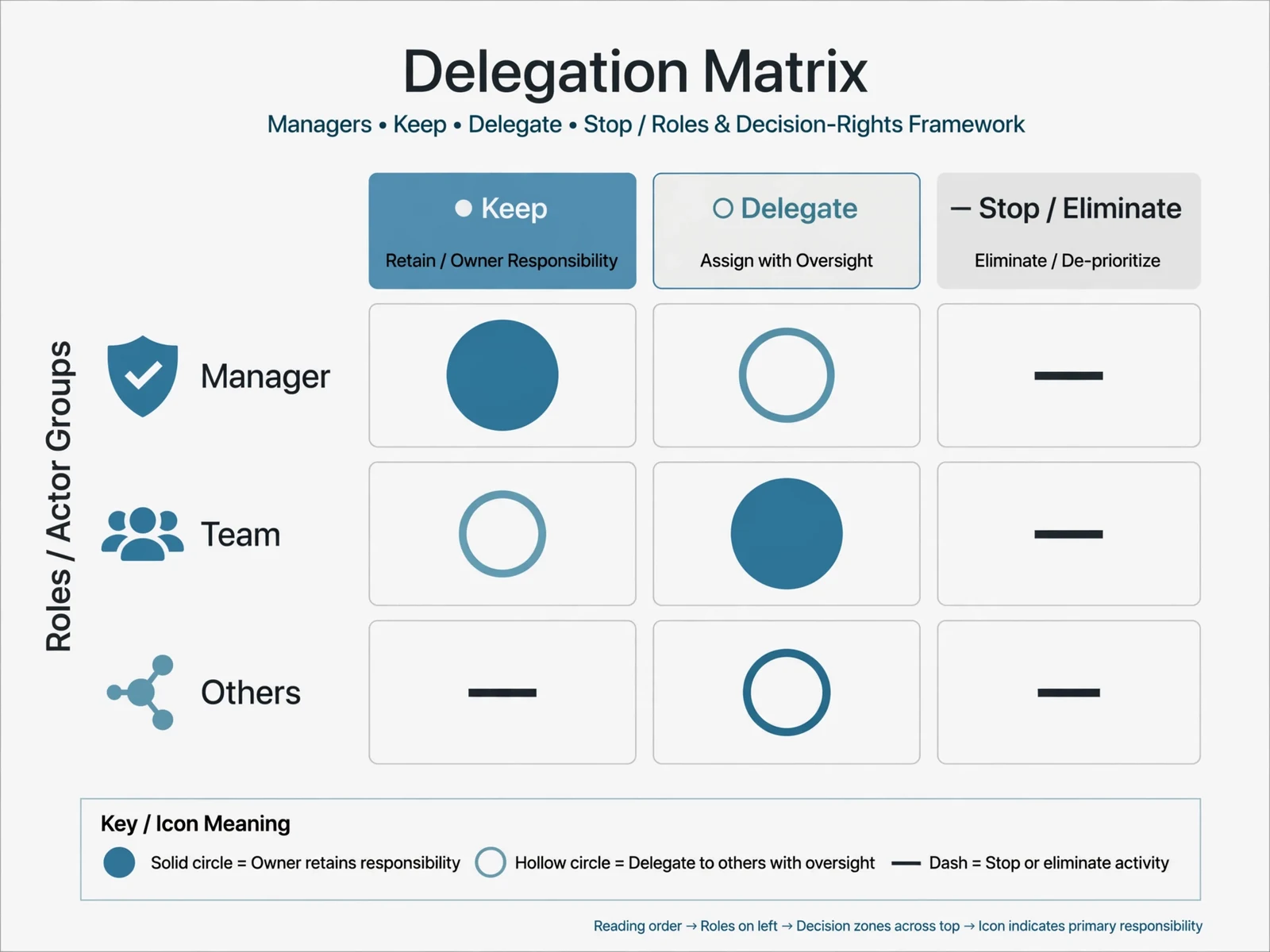
Category 1: Keep
Keep work that genuinely requires your authority, judgement, confidentiality, or accountability.
Examples might include:
- final performance decisions;
- sensitive employee matters;
- certain budget approvals;
- strategic prioritization;
- executive commitments;
- confidential negotiations.
Category 2: Delegate
Delegate work another person can own now with the right context and authority.
Good delegation candidates often include:
- recurring operational tasks;
- project work within clear boundaries;
- routine stakeholder communication;
- analysis someone else can perform;
- meetings the manager does not need to lead.
Category 3: Develop
Some work should move eventually, but the employee is not yet ready to own it independently.
Use staged delegation:
- observe;
- complete with support;
- recommend before deciding;
- decide within limits;
- own independently.
Category 4: Stop
Do not delegate work that should disappear.
Common examples:
- reports nobody reads;
- duplicate approvals;
- manual formatting with no business value;
- meetings with no decision or coordination purpose;
- legacy tasks nobody can explain.
Use Four Questions
1. Does this require my authority?
If no, delegation may be possible.
2. Does this create high value from my specific expertise?
If someone else can create the same result, your time may be better used elsewhere.
3. What is the risk if someone learns through doing?
High-risk work may require smaller steps or closer review.
4. Who would develop from owning it?
Delegation can build capability when work is matched thoughtfully.
Build a Weekly Delegation Audit
Review your calendar and task list.
Mark each item:
- K = keep;
- D = delegate;
- G = develop someone into it;
- S = stop.
The purpose is not to empty your calendar. It is to make sure your time matches your role.
Do Not Delegate Only the Boring Work
If employees receive only low-value tasks, they never build the capability required for more responsibility.
Include work that provides judgement, visibility, stakeholder exposure, and development where appropriate.
Define What Good Looks Like
Delegation fails when the employee receives responsibility without a clear standard.
State:
- outcome;
- deadline;
- quality;
- authority;
- constraints;
- checkpoints;
- escalation triggers.
Do Not Take Work Back Too Quickly
When difficulty appears, coach before rescuing.
Ask what the employee has tried and what they recommend.
Taking work back at the first problem teaches the team that difficult work ultimately belongs to the manager.
Add a Fifth Test: Frequency
Recurring work is often the best place to begin. If the same task returns every week or month, the cost of poor ownership compounds.
Ask whether a repeatable task can be transferred with a standard, checklist or decision rule rather than re-explained every time.
Score Delegation Candidates
For each task, rate:
- manager-specific authority required;
- business risk;
- repeatability;
- development value;
- employee readiness.
High-repeatability, moderate-risk tasks with strong development value are often excellent delegation candidates.
Use Delegation Levels
Delegation is not binary.
- Research and report back.
- Recommend an option.
- Decide with approval.
- Decide and inform.
- Own independently within agreed boundaries.
Move people through levels as capability grows.
Track the Manager’s Hidden Rework
Managers sometimes appear to delegate while quietly checking, rewriting and correcting everything afterward. That means the task has not truly moved.
If rework is frequent, diagnose whether the problem is unclear standards, insufficient training, poor fit, or manager preference.
Use Delegation to Build Succession
If nobody else can run an important process, client relationship or decision, the team has a continuity risk.
Delegation can deliberately create backup capability before absence, turnover or promotion forces the issue.
Delegation Review Template
- Task:
- Current owner:
- Future owner:
- Delegation level:
- Definition of done:
- Checkpoint:
- Escalation trigger:
Example: A Manager’s Real Workload
A manager may discover that their week contains client approvals, report formatting, recruitment interviews, team coaching, invoice checks, project decisions, and routine scheduling.
The matrix might classify them as:
- Keep: final recruitment decision, sensitive client negotiation, performance conversations.
- Delegate: routine report preparation, meeting coordination, standard client updates.
- Develop: project decision ownership, selected stakeholder meetings.
- Stop: duplicate reporting and approval of low-risk routine work.
The point is not the exact answer. It is making the allocation of work deliberate.
Review Delegation After 30 Days
Ask what moved successfully, what returned to the manager, and why. If work bounced back, identify whether the problem was unclear authority, poor briefing, missing skill, unrealistic workload, or unnecessary manager interference.
What Good Delegation Looks Like After Handover
The employee can explain the outcome, make routine decisions within agreed limits, identify when to escalate, and complete the work without hidden manager intervention.
The manager still owns overall accountability, but no longer needs to recreate or reapprove every step.
What to Do When Delegation Fails
Diagnose before taking the task back. Was the standard unclear? Did the person lack skill? Was authority too limited? Were checkpoints missing? Or did the manager interfere because the work looked different from their own style?
Revisit the Matrix as Roles Change
A task that belongs with the manager today may be appropriate for someone else six months from now. Review the matrix after promotions, new hires, major process changes, or team growth.
Where to Go Next
The Leading High-Performing Teams for Women Managers course develops delegation as part of a broader team operating system. Newer managers can start with the First-Time Manager Program for Women.
The goal of delegation is not to get rid of work. It is to place work at the right level of ownership while increasing team capability.
Develop this capability in your organization