Hiring decisions become unreliable when every interviewer asks different questions and then compares impressions instead of evidence.
A structured interview scorecard creates a common standard before interviews begin.
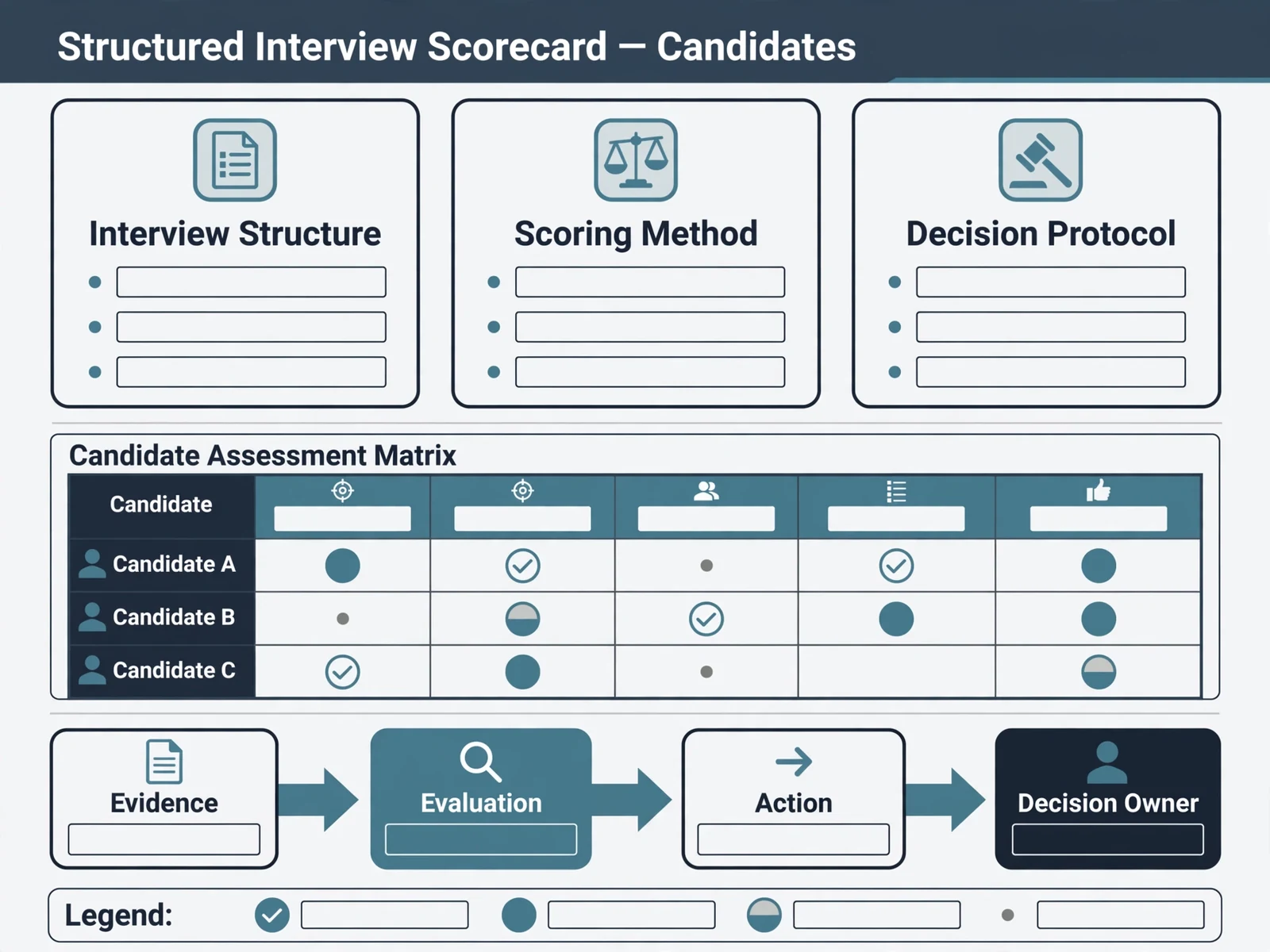
Start With the Role, Not the Candidate
Define what the role requires before meeting applicants.
Separate criteria into:
- critical outcomes;
- technical capability;
- behavioral capability;
- experience that is genuinely necessary;
- knowledge that can be learned;
- constraints such as schedule, language, location, or licensing.
Use a Small Number of Meaningful Criteria
A scorecard with twenty vague competencies creates false precision.
Choose perhaps five to eight criteria that actually predict success in the role.
For example:
- client communication;
- problem-solving;
- commercial judgement;
- role-specific technical capability;
- planning and follow-through;
- team collaboration.
Define What Good Evidence Looks Like
For each criterion, describe observable evidence.
Example for stakeholder management:
- identifies stakeholder interests;
- adapts communication;
- handles disagreement;
- can describe a real example and outcome.
Ask the Same Core Questions
Interviewers can ask follow-up questions, but each candidate should receive the same core questions for the key criteria.
This improves fairness and comparison.
Use Behavioral Questions
Ask for specific examples.
“Tell me about a time you had to influence a stakeholder who did not report to you. What was the situation, what did you do, and what happened?”
Then probe for the candidate’s actual role rather than accepting a team story with unclear ownership.
Score Before Group Discussion
Each interviewer should record their assessment before hearing everyone else’s opinion.
This reduces the risk that the most senior or confident interviewer anchors the group.
A Simple Five-Point Scale
- 1: little relevant evidence.
- 2: partial evidence with significant gaps.
- 3: meets the expected standard.
- 4: strong evidence above the expected standard.
- 5: exceptional evidence directly relevant to the role.
Define the scale in advance so “4” means roughly the same thing to different interviewers.
Separate Evidence From Likeability
A candidate can be engaging without being the strongest fit. Another can be less polished but provide better evidence.
Ask:
“What evidence supports this score?”
Include a Work Sample Where Appropriate
A realistic work task can reveal capability that interviews miss.
Examples:
- write a short client response;
- analyse a small data set;
- prepare a project plan;
- review a case and make a recommendation;
- role-play a relevant conversation.
Document the Final Decision
The hiring team should be able to explain why the selected candidate best met the agreed role criteria.
Scorecard Template
- Criterion
- Weight or importance
- Core interview question
- Evidence observed
- Score 1-5
- Concern / risk
- Follow-up required
Calibrate the Interview Panel Before the First Candidate
Interviewers should agree what the criteria mean before scoring real people.
Take one criterion and discuss what a 2, 3, and 4 would look like. This exposes differences in interpretation early.
Assign Interview Responsibilities
A panel becomes repetitive when every interviewer tries to assess every criterion.
Divide responsibility.
For example:
- hiring manager: role outcomes and judgement;
- peer: collaboration and operating style;
- specialist: technical capability;
- senior stakeholder: stakeholder communication and broader fit.
Everyone can contribute to the final decision, but each person should know what evidence they are primarily responsible for gathering.
Use Follow-Up Questions Consistently
Behavioral answers often need probing.
Useful follow-ups include:
- What was your specific responsibility?
- What did you personally decide?
- What resistance did you encounter?
- What happened as a result?
- What would you do differently now?
Use similar depth across candidates so one person is not given more opportunity to prove capability than another.
Watch for Common Bias Patterns
Structured interviewing does not eliminate bias automatically.
Watch for:
- Similarity bias: preferring people who think or communicate like the interviewer.
- Halo effect: allowing one impressive trait to lift every score.
- Horn effect: allowing one weakness to dominate the whole assessment.
- Prestige bias: overvaluing employer names or education without evidence of role capability.
- Recency bias: favoring the most recent candidate because details are easier to remember.
The scorecard helps only if interviewers use it honestly.
Use Work Samples Carefully
A work sample should resemble the actual job and be proportionate to the role.
Do not ask candidates to produce unpaid commercial work the company could use.
Give the same task, time, information, and evaluation standard to comparable candidates.
Run the Debrief in Evidence Order
At the debrief:
- each interviewer submits scores;
- review the strongest evidence;
- review material concerns;
- compare against role criteria;
- identify gaps requiring reference checks or follow-up;
- make the decision.
Avoid starting with “who did everyone like?”
Protect Candidate Experience
Structure should not make the interview robotic.
Explain the format, leave time for candidate questions, and treat the process professionally. A consistent interview can still be human.
Reference Checks Should Test Risk
Do not ask only whether the referee liked the candidate.
Use the reference to test specific questions that remain after the interview, subject to appropriate consent and local requirements.
Scorecard Example
For a client-facing project manager, the criteria might be:
- project planning – 20%;
- stakeholder management – 20%;
- commercial judgement – 15%;
- risk management – 15%;
- communication – 15%;
- team leadership – 15%.
The weighting should reflect the real job, not a generic competency library.
Audit the Scorecard After Hiring
Once the new hire has been in role long enough to assess performance, review whether the interview criteria predicted success. If a criterion repeatedly produces little value, improve or remove it. If a critical capability was missed, add it to future scorecards.
Where to Go Next
The Talent Acquisition and Recruitment Strategies course covers role definition, sourcing, structured selection, interviewing, candidate evaluation, and onboarding. Women business owners hiring their first team can use Hiring, Delegation and People Systems for Women Business Owners.
A structured interview does not remove judgement. It gives judgement better evidence.
Develop this capability in your organization